Motivate THE CREATIVE
Across the past month, the four of us have explored the world of creativity and the countless factors that motivate it. Through a collection of five photos, explore what we've learnt about how YOU can live a more fulfilling creative life. Many may think creativity comes and goes like a muse, but in reality we have the power to control its otherwordly abilities through nature, incubation and intrinsic drive.
Scroll to explore ↓
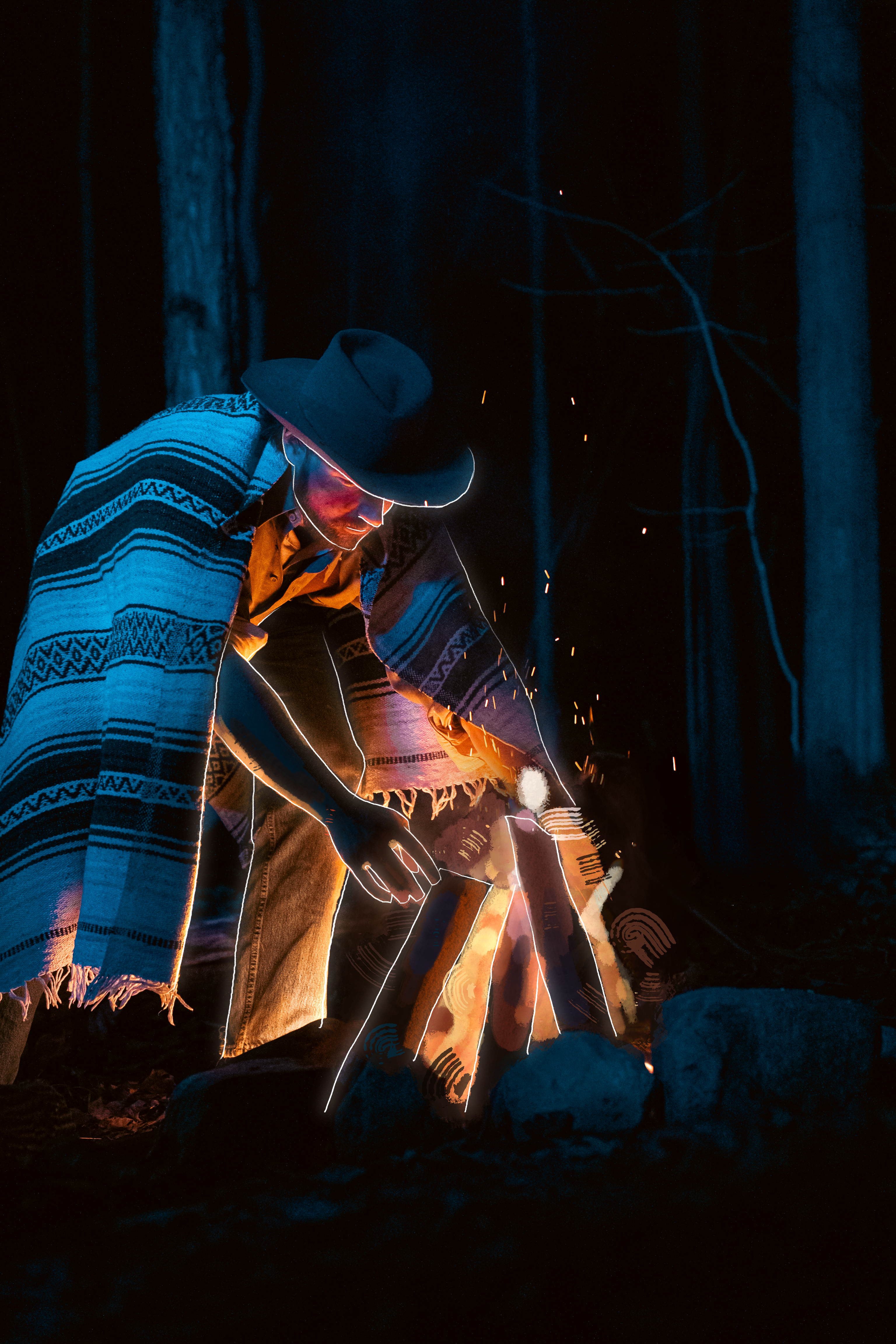
Igniting Inspiration
In the stillness of a dark forest, a lone figure bends to light a fire—a quiet act representing the beginning of creativity. Sparks rise like fragile ideas, glowing outlines blur the line between real and imagined, and the warm fire cuts through the deep blue night. Inspiration is born when we dare to bring light into uncertainty, turning silence into energy and solitude into creation. This moment reflects the powerful role of intrinsic motivation in fostering creativity, where the act of engaging with a task for its inherent satisfaction can lead to innovative outcomes (Amabile & Pratt, 2016; Ryan & Deci, 2000). The focused, autonomous nature of tending the fire also highlights how self-determination and personal interest are crucial drivers for creative expression and problem-solving (Ryan & Deci, 2000; Tierney & Farmer, 2002).
Beyond the Horizon
A sketched traveler overlooks an autumn valley, their outline dissolving softly into the sky. The figure becomes a reflection of the mind expanding beyond what is visible. Creativity here is not loud—it is the calm shift between observation and vision, when stillness becomes perspective and imagination begins to move. The expansive view from the vista suggests the power of environmental factors and cognitive broadening on creative thought. Exposure to natural environments is shown to enhance cognitive flexibility and attention restoration, thereby fostering the open-minded state necessary for novel idea generation (Goldsworthy, 2000). Furthermore, the act of seeing new possibilities relates to creative self-efficacy— the belief in one's own ability to produce creative outcomes (Tierney & Farmer, 2002). This perspective shift enables the individual to move from simple observation to actively forming a creative vision and finding solutions that are truly "beyond the horizon."

Unexpected Light
On a rough stone wall, a faint rainbow shimmers under sunlight. The solid texture meets delicate hand-drawn sparkles, echoing how grounded thinking and curiosity coexist. This piece celebrates the beauty of chance—the small, unplanned discoveries that awaken imagination when we take the time to notice. The image of the rainbow, a product of light meeting water, reflects the concept of psychological safety within creative environments. Psychological safety is defined as a shared belief that the team or environment is safe for interpersonal risk-taking, allowing individuals to express nascent or unusual ideas without fear of negative consequences (Edmondson, 1999). This sense of safety is crucial because creative breakthroughs often rely on the willingness to share ideas that may initially seem imperfect or surprising—the "unexpected light." The spontaneous nature of the discovery highlights the importance of exploration and curiosity. Curiosity drives individuals to engage in new and challenging tasks, which are essential for innovation (Zhou & George, 2001). When individuals feel safe to explore and deviate from the planned path, they are more likely to encounter these unplanned discoveries and turn them into creative results (Edmondson, 1999; Gilson & Shalley, 2004).
Flow of Imagination
A hand sketches a dreamlike world as color spills from the page into the air. The swirling motion represents imagination in flux—messy, vivid, and unstoppable. This piece celebrates the creative overflow, when ideas refuse containment and instead transform the space around them. This state of unrestrained creativity strongly aligns with the concept of flow. Flow is a mental state where an individual is fully immersed in an activity, characterized by feelings of energized focus, full involvement, and enjoyment in the process (Amabile & Pratt, 2016). The feeling of the idea spilling off the page suggests the deep intrinsic enjoyment that comes from being completely absorbed in the creative process. The image also highlights the connection between team engagement and the creative output shown on the page. When individuals are part of a supportive and engaged team, they are more likely to achieve deep immersion in their tasks, which ultimately enhances the quality and quantity of creative outcomes (Gilson & Shalley, 2004). The freedom shown in the sketch represents the positive impact of a work environment that supports uninhibited, imaginative expression (Zhou & George, 2001).

Dual Forces
Red and blue hands reach toward a glowing core, embodying both tension and balance. Emotion and logic, warmth and coolness, human touch and digital light converge. Every creative act exists within this dynamic balance, turning contrast into connection and difference into energy. This powerful visual of balancing dual forces directly relates to the concept of synergistic extrinsic motivators acting alongside intrinsic motivation (Amabile & Pratt, 2016). Intrinsic motivation (the inherent interest, perhaps the 'human touch') is the core engine, but creativity is often maximized when supported by an extrinsic context (the 'digital light'), such as challenging deadlines or constructive feedback, provided these motivators are not controlling. The "dynamic balance" shown is necessary to avoid extinguishing the internal drive. the tension between the opposing colors reflects the importance of personal and contextual characteristics in creativity (Shalley, Zhou, & Oldham, 2004). Creative tension arises not just from individual cognitive differences (red vs. blue hands) but also from the organizational context that surrounds them. A manager's role is to harness this tension—the interaction of different ideas and perspectives—into productive energy, ensuring the environment supports creative risk-taking rather than stifling it (Shalley, Zhou, & Oldham, 2004).
References
- Amabile, T. M., & Pratt, M. G. (2016). The influence of intrinsic motivation and synergistic extrinsic motivators on creativity and innovation. Journal of Applied Psychology, 101(8), 1189–1200.
- Edmondson, A. (1999). Psychological safety and learning behavior in work teams. Administrative Science Quarterly, 44(2), 350–383.
- Gilson, L. L., & Shalley, C. E. (2004). A little creativity goes a long way: An examination of teams’ engagement in creative processes. Journal of Management, 30(4), 453–470.
- Goldsworthy, A. (2000). From natural to novel: The cognition-broadening effects of contact with nature at work on creativity. Environmental Psychology Review, 22(4), 120–132.
- Ryan, R. M., & Deci, E. L. (2000). Self-determination theory and the facilitation of intrinsic motivation, social development, and well-being. American Psychologist, 55(1), 68–78.
- Shalley, C. E., Zhou, J., & Oldham, G. R. (2004). The effects of personal and contextual characteristics on creativity: Where should we go from here? Journal of Management, 30(6), 933–958.
- Tierney, P., & Farmer, S. M. (2002). Creative self-efficacy: Its potential antecedents and relationship to creative performance. Academy of Management Journal, 45(6), 1137–1148.
- Zhou, J., & George, J. M. (2001). When job dissatisfaction leads to creativity: Encouraging the expression of voice. Academy of Management Journal, 44(4), 682–696.